 AI WORLD HQ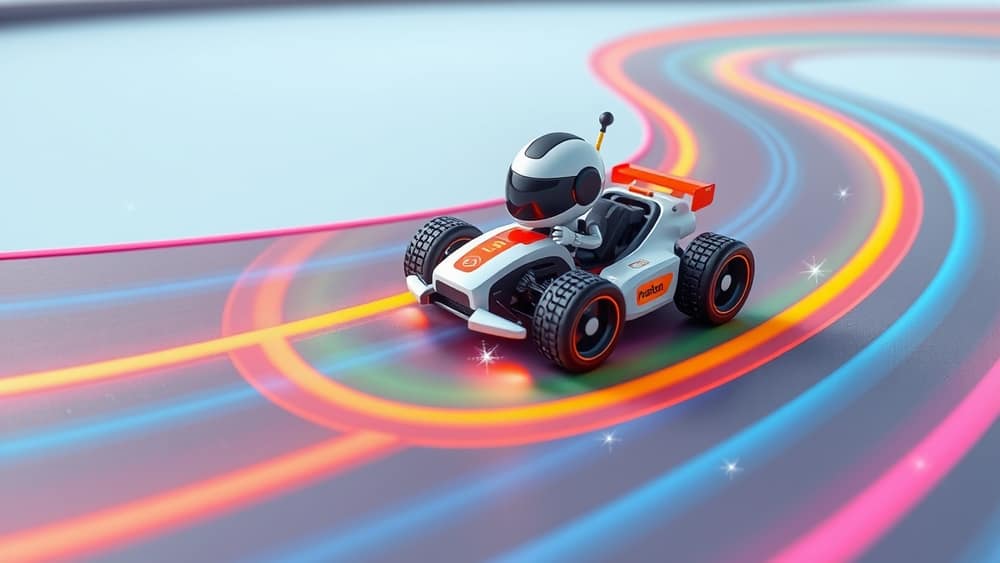
How AI Learns to Race (and What That Teaches You About Daily Life)
Picture this: you're stuck in slow-moving traffic, and you're watching an experienced driver sail past in the fast lane. How did they get so good? Practice, feedback, and a million tiny adjustments along the way. AI can learn the same way — and one of the most surprising examples comes from inside a video game.
What is reinforcement learning, really?
Reinforcement learning (RL) is a way of teaching an AI by letting it try things, see what works, and keep doing more of what works. Think of it like training a puppy with treats. The puppy sits, gets a treat, learns that sitting is good. Repeat a few thousand times and you've got a very polite dog.
An RL system works the same way, only it's playing a video game instead of fetching a ball. The AI tries an action, gets a "reward" signal (a point, a faster lap time, a cleaner racing line), and adjusts its behaviour for next time. Over millions of attempts, it gets remarkably clever.
The key idea is that nobody tells the AI how to drive. Nobody hands it a rulebook. It figures out its own strategy purely through trial, error, and feedback.
Why a racing game became a milestone
Racing simulations are a brilliant testing ground for AI because they're easy to measure. You're either faster or you're not. You either stayed on the track or you didn't. That clear feedback loop is exactly what reinforcement learning needs to thrive.
A few years ago, a team of researchers set out to build an AI racing agent that could compete with the world's best human players in a popular PlayStation driving simulator. The agent trained for hours upon hours — the equivalent of hundreds of years of human driving experience — until it could brake later, take tighter lines, and anticipate opponents in ways that genuinely surprised professional drivers.
What made it special wasn't just speed. It was style. The AI developed its own personality on the track — sometimes cautious, sometimes wildly aggressive — based purely on what its reward system rewarded.
Where you see reinforcement learning every day
You might never play a racing simulator, but you almost certainly use RL-powered systems without realising it:
- Navigation apps suggest faster routes by learning from millions of past trips.
- Streaming services recommend what to watch next by trial-and-error on what you finish.
- Spam filters get better at catching junk mail because they've been rewarded for catching it (and punished for letting it through).
- Smart thermostats learn your comfort patterns and adjust the temperature automatically.
- Robot vacuums map your home and improve their cleaning routes with every run.
Same idea, smaller stakes. Trial, feedback, improvement.
Wrap-up
Reinforcement learning is one of the simplest and most powerful ideas in modern AI: try, get feedback, try again. The same approach that taught an AI to out-brake professional drivers is quietly helping your maps, your playlists, and your inbox get smarter every week.
If you want a small experiment today, open a navigation app and take a different route than usual — then check whether the app suggests something better next time. That's reinforcement learning in action, right in your pocket.