 AI WORLD HQ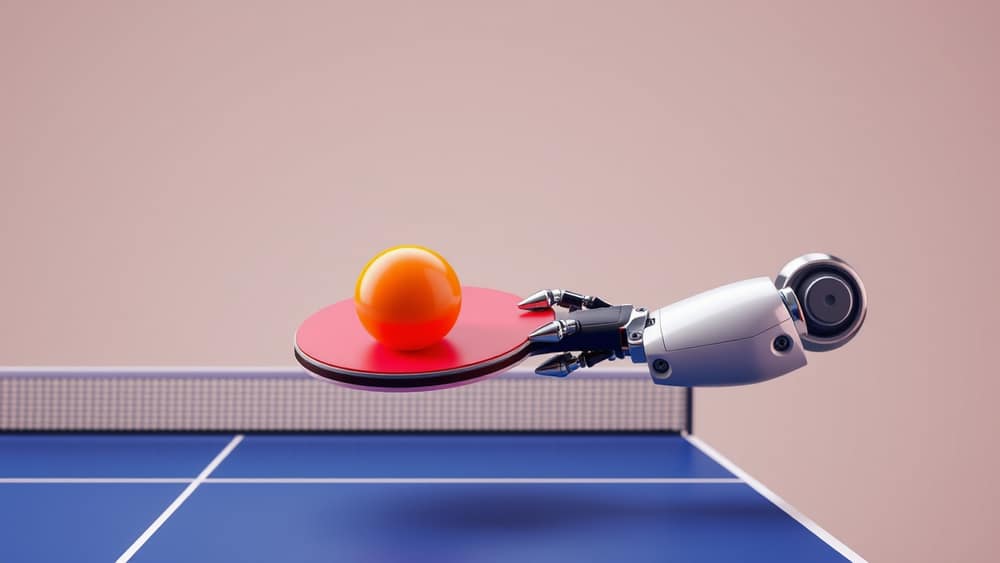
When AI Learns to Play Table Tennis: What It Means for Everyday Life
Picture this: you're at your local sports centre, knocking a ball back and forth with a training partner. Except your partner isn't a person. It's a robotic arm that reads your spin, predicts your shots, and keeps the rally going for as long as you want to play. Sounds like science fiction? It's already happening, and it tells us something important about where AI is heading next.
A new kind of AI breakthrough
Sony AI, the artificial intelligence research division of Sony, recently published the results of a five-year project: an AI system that can play table tennis at a competitive amateur level. It adjusts to your skill, changes its playing style mid-rally, and can even match your pace so the exchange stays fun. The work was published in Science Robotics, a peer-reviewed journal (meaning other independent scientists checked the results before they were released), which is a strong sign of the quality involved.
But here's the thing: this isn't really about table tennis. It's about AI leaving the screen and entering the physical world.
Why physical AI is different
Most AI you use today (chatbots, image tools, voice assistants) lives entirely inside a computer. It deals with text, pixels, and sound. It never has to worry about gravity, friction, or a ball moving at 80 kilometres an hour.
Table tennis is a brilliant test case because it forces AI to handle all of these at once. To return a serve, the system has to:
- See the ball clearly, often in messy, real-world lighting
- Predict where the ball will land in a fraction of a second
- Move a physical arm with the right speed, angle, and spin
- Adapt on the fly when the human does something unexpected
The technical term for this kind of learning is reinforcement learning. In plain English, that means the AI learns by trying things, seeing what works, and trying again. Think of it like learning to ride a bike: you wobble, you fall, you adjust, and eventually it clicks. The AI does the same thing, just millions of times faster.
What this trend really means
If AI can master a fast, physical sport, the same techniques can be used in plenty of other places. Researchers around the world are working on physical AI for:
- Sorting packages in warehouses
- Helping nurses lift and move patients safely
- Assisting with kitchen tasks at home
- Supporting surgeons in operating theatres
- Tidying and cleaning in everyday environments
Each of these is messier, slower, and harder than writing an email. That's exactly why progress here takes years. But it also explains why companies keep investing in it. The next wave of useful AI won't just answer your questions. It'll actually do things alongside you.
Wrap-up
An AI that can rally with you at a table tennis club sounds like a fun novelty, but it actually points to a much bigger shift: AI learning to exist in the real world, not just on a screen. The same techniques that return a serve could eventually help in kitchens, hospitals, warehouses, and homes. Today's takeaway? Don't judge AI's progress by chatbots alone. The next chapter is being written in robotics labs right now, and it will reach your daily life sooner than you might expect. A simple first step: try asking a chatbot today what "physical AI" means, and see where the conversation takes you.