 AI WORLD HQ
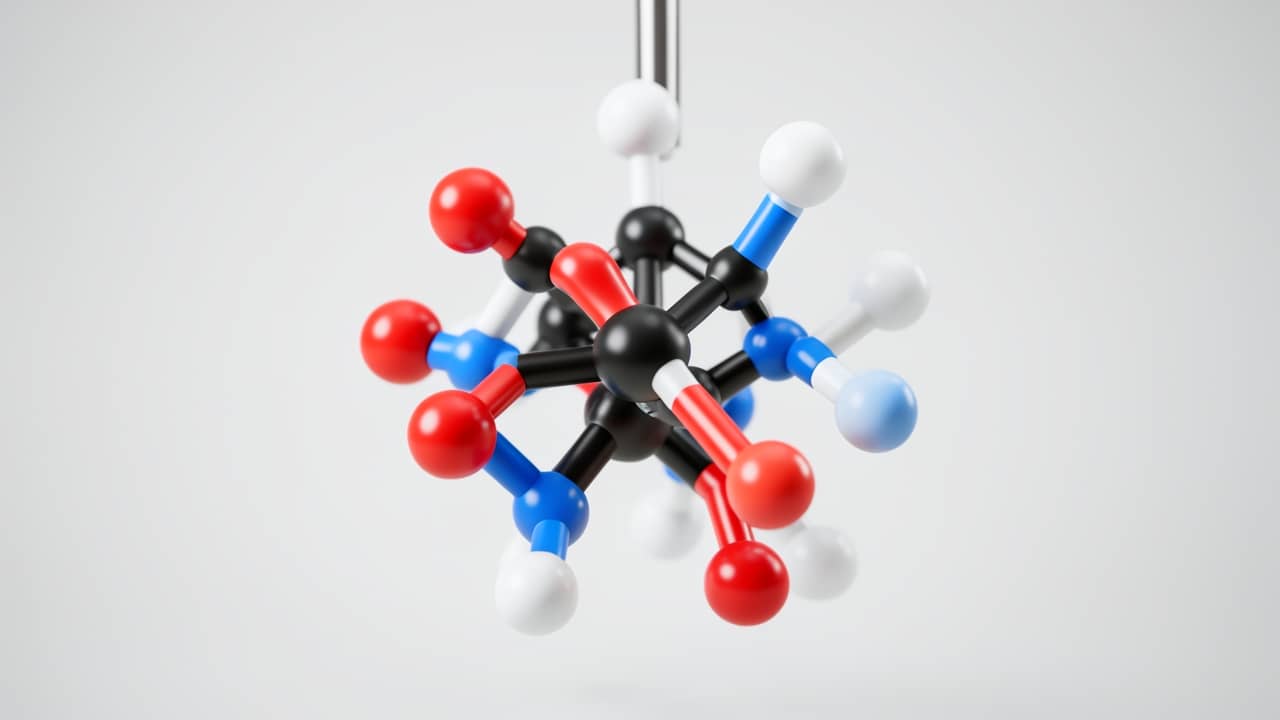
Think about baking a cake where adding more sugar makes it sweeter but also makes it collapse. Fixing one problem often creates another. Drug researchers face this kind of puzzle constantly, and a new OpenAI benchmark asks whether AI can help them think it through.
Why drug design is a balancing act
The field is called medicinal chemistry (the science of designing molecules that might become medicines). A molecule is a small group of atoms joined together, and a compound is a specific molecule a researcher is studying.
A promising compound can have a serious weakness. OpenAI's announcement gives an example: a compound may block a disease-related protein (a large molecule in the body that does a specific job, and that a drug can target) very effectively, yet pass poorly into the body or break down too fast. Researchers handle these tradeoffs by designing related compounds, testing them, and deciding what to try next.
What MedChemBench actually tests
A benchmark is a standard set of test questions with a scoring guide, a bit like a practice exam that every student takes under the same rules. OpenAI says MedChemBench draws on 117 papers and patents and includes 761 distinct molecular structures.
According to the company, the benchmark grades four skills:
- Molecular structures: Can the model correctly assemble a molecule from drawings and chemical groups? This includes stereochemistry, which is the three-dimensional arrangement of atoms.
- Scientific reasoning: Does the model explain its choices using the evidence it was given?
- Ranking and selection: Does it rank or choose compounds that meet the stated requirements?
- Property predictions: Do its predicted values and categories match the measured numbers in the source research?
Most problems give the model context from a point in a research project: the biological target, the researchers' goals, the compounds tested so far, and some experimental findings.
How the scoring works
OpenAI reports results as a percentage of the available credit. For property predictions, the benchmark gives partial credit, which means a prediction earns more credit the closer it lands to the measured value, instead of counting only as right or wrong. The measurements already supplied in a problem must also be reproduced correctly.
The announcement does not publish the exact scoring formula, so you can't tell from it precisely how much a near-miss is worth. Treat the percentages as a helpful comparison point inside OpenAI's own test, not as a precise measure of scientific skill.
A closer look at one example
One problem focuses on inhibitors of PRMT5, a protein studied in cancer drug discovery. (An inhibitor is a molecule that slows or blocks a protein's activity.) The model receives structures and early results, then predicts how three related compounds will behave in three ways: how strongly they block PRMT5 in cells, how easily they cross a cell barrier, and how quickly liver enzymes break them down in a lab assay.
Later experiments, which were hidden from the model, showed a tradeoff. One compound blocked PRMT5 at a lower concentration, while another crossed the cell barrier more readily and broke down more slowly.
The company also highlights a basic step: before a model reasons about a compound, it has to draw the molecule correctly. OpenAI reports that a change to a single ring of atoms can produce a completely different molecule, which is why the structure test matters.
Wrap-up
MedChemBench tests whether AI models can read molecules, reason from lab evidence, rank compounds, and predict properties, using 99 problems drawn from published research. OpenAI presents it as a way to measure progress toward helping scientists design better medicines. Your next step is simple: open the official announcement, read the PRMT5 example, and notice how the test rewards careful reasoning, not just a confident answer.