 AI WORLD HQ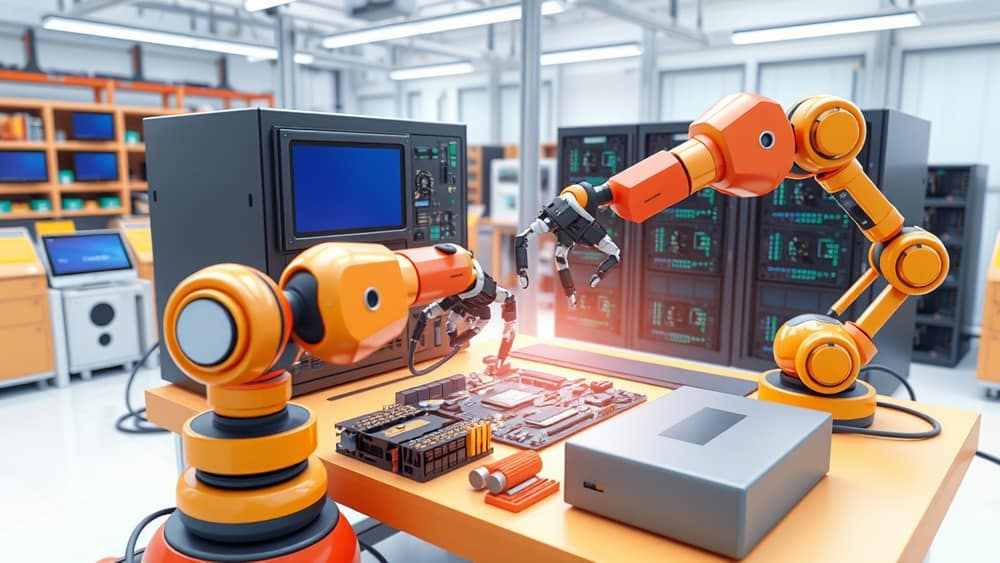
Building an AI Factory: Scaling AI for Your Business Operations
Imagine your business has unique challenges that off-the-shelf AI solutions can't quite solve, or perhaps you need to use AI across many different departments. What if you could build and manage a range of custom AI tools, tailored precisely to your company's needs, all within your own secure environment?
The Rise of the Enterprise AI Factory
For many years, businesses adopted individual AI tools for specific problems – one AI for customer service, another for marketing analysis. While helpful, this often led to a patchwork of disconnected systems. The concept of an Enterprise AI Factory represents a strategic shift: it's a dedicated internal capability within a business to rapidly develop, deploy, and manage multiple, custom-built AI applications.
Think of it like a production line for AI. Instead of buying individual AI products, your business sets up the infrastructure, processes, and expertise to continually design, build, and launch custom AI tools, much like a manufacturer produces various goods. This "factory" approach allows organisations to integrate AI deeply into their operations, ensuring consistency, security, and scalability.
This means:
- Tailored Solutions: Developing AI that understands your company's specific data, language, and workflows precisely.
- Faster Innovation: Quickly creating new AI tools as business needs evolve and new opportunities arise.
- Centralised Control: Managing all your AI models (the core 'brains' of AI applications, trained on data to perform specific tasks) and data securely under one roof.
- Efficiency: Automating repetitive tasks across various departments with bespoke solutions.
How an Enterprise AI Factory Comes Together
Building an AI factory isn't about buying a single product; it's about setting up an ecosystem. Here's a simplified look at the key components:
1. The Right Infrastructure
At its core, an AI factory relies on robust computing power and data storage. Many businesses leverage cloud computing platforms like Amazon Web Services (AWS), Microsoft Azure, or Google Cloud. These provide the massive resources needed for training and running complex AI models without the huge upfront investment in physical hardware. They also offer tools for managing data, running machine learning tasks, and securely deploying (getting an AI model ready and available for use within a business system) your AI applications.
2. Custom AI Models
Instead of relying solely on general-purpose AI, an AI factory focuses on creating or fine-tuning models for specific business tasks. This might involve using powerful open-source models like Meta's Llama series or Mistral AI's models as a starting point. These base models are then trained further with your company's proprietary (private and unique) data. For example, a financial institution might train an AI to analyse its specific fraud patterns, or a retailer might build a model to predict demand for its unique product lines.
3. Streamlined Development and Deployment
The "factory" aspect means having efficient, repeatable processes. This often involves using Machine Learning Operations (MLOps) practices. MLOps is like a blueprint for how AI models are developed, tested, deployed, and monitored throughout their lifecycle. It ensures that new AI tools can be built, updated, and launched quickly and reliably, often with automated checks and balances, and that their performance (scalability) can grow with your business needs.
Wrap-up
The Enterprise AI Factory represents a maturing of AI adoption in business – moving from ad-hoc solutions to a structured, scalable approach. By setting up internal capabilities to build and manage custom AI tools, companies can drive deeper innovation, maintain greater control over their data, and truly tailor artificial intelligence to their unique needs. Consider how a dedicated AI factory could fuel your business's future growth and efficiency; taking the first step might involve exploring cloud AI services or identifying a pilot project where a custom AI solution could make a significant impact.